First we shape our organizations,
then our organizations shape us.
The Bottleneck in Founder’s Clothing
arah had always thought of hiring as filling seats. At her old firm, it was mechanical: post a listing on the recruiting portal, interview a bunch of candidates from a range of leading and regional law schools, select the ones who looked ‘best’ during their summer associate programs, repeat annually. The pyramid required bodies. The partnership agreement specified how many associates each partner could supervise. Human resources handled the rest.
Building her own firm was nothing like that. Every hire changed the shape of the organization. Every person she brought on shifted the culture, the capabilities, the economics. With such a small team the margin for error was zero. A bad hire at this size would not get buried in a class of twenty associates. A bad hire would be a double digit percent of the company.
It was late on a Tuesday evening in her downtown Phoenix office when the weight of the problem hit her. She had just closed another major client engagement—a regulatory compliance review for a mid-sized healthcare system that would have taken a traditional firm six weeks and cost the client north of $200,000. Her team delivered it in nine days for $85,000, with margins that made the economics work. The client was thrilled. Sarah was exhausted. The Allison McLindon engagement she had won a few weeks earlier was starting to stretch the team thin, and two more prospects were in the pipeline.
The work is here. The demand is real. But I cannot scale myself.
She stared at the whiteboard in her office, covered in scribbled workflow diagrams and client timelines. With Claude Code subbing in for a larger software development team, a decent percentage of the seed capital was still in the bank. It was amazing times in the world of programming where the work of many developers could be done by a smaller more focused team. The goal was to extend that idea beyond just software and to the broader world of service delivery. The question was no longer whether she could afford to hire. But who should she hire. How could she create the culture of AI-native law and not simply recreate the pyramid she had left behind.
David Park had been transforming the firm’s operations for months now, but the organizational question was different from the workflow question. Building processes was one thing. Building the structure to hold those processes—the roles, the teams, the governance—was another.
She texted David: “Need to talk about org design. Tomorrow morning. Lux Coffee. 7 AM.”
Lux Central was crowded at seven, a long line of downtown quasi-hipster professionals ordering oat milk lattes and cold brews had developed. Sarah had arrived first and claimed a corner table. David appeared five minutes later, looking somewhat out of place wearing his usual uniform of pressed chinos, a plain white oxford, and running shoes that looked like they had actually been used for running. He carried his usual worn Moleskine notebook and a high-end mechanical pencil.
“Let’s talk about scaling,” he said, before he had even sat down.
Sarah laughed. “Good morning to you too.”
“Sorry. Occupational hazard.” He set down his coffee. “I have been thinking about this since the board call. We have a classic bottleneck problem disguised as a growth problem.”
“Explain.”
“You are the bottleneck. You review every AI output before it goes to the client. You train every new lawyer on your verification protocols. You handle every client relationship. You are the single point through which all value flows.” He opened his notebook to a page covered in diagrams. “That is fine when you are doing five engagements a month. It is fatal when you are doing twenty.”
Sarah sipped her coffee. He was right, and she knew it. “So what do I do? Hire a managing partner? Build a traditional hierarchy?”
“No.” David shook his head emphatically. “That is what a law firm would do. You are not building a law firm. You are building a production system that happens to deliver legal services. The organizational design should follow from the production system, not from legal industry convention.”
“What does that look like?”
The Anti-Pyramid
David flipped to a clean page and drew three circles arranged in a triangle. Inside each circle, he wrote a role: Senior Lawyer, Legal AI Engineer, Legal Quality Analyst.
“Pods,” he said. “Small, cross-functional teams that own client outcomes end-to-end. Each pod has three core roles. A senior lawyer who provides legal judgment and manages the client relationship. A Legal AI engineer who designs, monitors, and tunes the AI pipelines for that pod’s work. And a Legal Quality Analyst who independently verifies outputs before they reach the client.”
The idea of embedding an engineer directly inside a client-facing team was not new. Palantir had pioneered the concept of the “forward deployed engineer,” a technical builder who sat with the customer rather than back at headquarters, translating real problems into working software in real time. David’s pod model took the concept one step further. There was nothing more forward deployed than putting the engineer permanently inside the delivery unit itself, working shoulder to shoulder with the lawyer and the quality analyst on every engagement. The engineer was not support staff parachuting in from a central technology team. The engineer was core to the team.
The reason the forward-deployed model mattered so much in legal services was a problem that had quietly been killing product companies for years: last mile customization. ContractZoo and its competitors built generic platforms designed to serve the broadest possible market. But legal work was not generic. A healthcare company’s vendor contracts required different risk frameworks than a manufacturing company’s supply agreements. An FDA-regulated entity has certain needs that a real estate developer or regional bank did not. Every client, every industry, every jurisdiction introduced variations that a one-size-fits-all product could not handle without degrading quality.
The product companies knew this. They tried to solve it with configuration options, template libraries, industry-specific modules. But the variations were too granular, too context-dependent, too entangled with the specific facts of each client’s business. The customization problem was not a bug in their product strategy. It was a structural limitation of the product model itself when applied to professional services.
What had changed was that low-cost customization was now genuinely manageable—so long as the engineering resources stayed close to the problem. A Legal AI engineer embedded in a healthcare regulatory pod understood the specific failure modes of FDA compliance analysis because she saw them every day. She could tune the pipeline for a particular client’s contract structure in an afternoon. A centralized engineering team at a product company would need a feature request, a product manager, a sprint planning meeting, and a six-week development cycle to achieve the same result—if they achieved it at all. The pod model turned customization from a cost center into a competitive advantage. Every client-specific adaptation made the pod smarter, and the platform captured those adaptations for future use across the firm.
David acknowledged “That is not how law firms work and that is the point.” He tapped the diagram. “Think about how a surgical team works. You do not have the surgeon doing everything—cutting, monitoring vitals, administering anesthesia, counting sponges. You have a team of specialists, each with a defined role, working in coordination. The surgeon provides the critical judgment. Everyone else ensures the system produces a safe outcome.”
“And the pod owns the whole engagement?”
“End to end. From client intake through final delivery. No handoffs between departments. No work queuing in some central pool waiting for assignment. The pod takes the engagement, runs it through their workflows, and delivers the result. If there is a quality issue, the pod fixes it. If the client needs something adjusted, the pod handles it. Sarah you need to keep your powder dry because you are the escalation for the team members. You are the escalation for an unhappy client.”
Sarah studied the diagram. “What happens to the traditional associate role? The junior lawyers doing document review, first drafts, research?”
“In a pod model, that work is done by AI, supervised by the workflow engineer and verified by the Legal Quality Analyst. You do not need associates grinding through documents. You need senior lawyers who can exercise judgment on what the AI produces, engineers who can build and maintain the pipelines, and analysts who can catch errors systematically.”
“That eliminates the entire bottom of the pyramid.”
“It replaces the bottom of the pyramid with technology and a different kind of human oversight.” David leaned forward. “The pyramid exists because labor was the only way to scale professional output. You needed more bodies to do more work. AI changes that equation. You need more compute, not more bodies. But you still need humans—just different humans doing different things.”
Sarah was quiet for a moment. She could see it—the logic was sound. But the implications were enormous. A law firm without junior associates was not just structurally different. It was culturally alien. It broke the apprenticeship model, the training pipeline, the entire career progression that the profession was built on.
“This is your project,” Sarah said. “I need a full organizational blueprint—pods, roles, governance—ready in the next few weeks.”
David closed his notebook. “I have half of it sketched already.”
David threw himself into the work. The task was straightforward in concept and staggering in scope: design the organizational structure for a firm that did not yet exist at the scale they were planning.
The organizational question was inseparable from the technology question. Priya had spent months rebuilding the firm’s AI infrastructure, replacing Sarah’s original duct-tape integrations with the five-layer architecture they had designed together. The platform could scale. The question now was what kind of human organization to build around it.
Priya sat with the lawyers, not in a separate engineering wing, and that proximity shaped everything she built. The technology and the practice were designed together, by people who understood both.
David spent his first three weeks designing the organizational blueprint. He commandeered the largest whiteboard in the office—which was also the only whiteboard in the office—and mapped out the pod model in detail.
The fundamental unit of the firm would be the pod. Each pod would consist at least of the following: senior lawyer, Legal AI engineer and Legal Quality Analyst. The senior lawyer would own the client relationship and provide legal judgment on all matters within the pod’s scope. The Legal AI engineer would design, configure, and monitor the AI pipelines that processed the pod’s work. The Legal Quality Analyst would independently review all outputs before client delivery, tracking error rates, identifying patterns, and feeding corrections back into the system.
Pods would own outcomes end to end. When a client engagement came in, it would be assigned to a pod. That pod would handle everything from intake through delivery. There would be no central work pool, no assignment committee, no partner doling out tasks to a bullpen of associates. The pod was autonomous, responsible, and accountable.
David drew the structure on the whiteboard for the full team on a Thursday afternoon. The diagram showed how the pieces fit together: pods at the top delivering client work, Candor OS in the middle connecting everything, and the three of them at the bottom supporting the whole system.
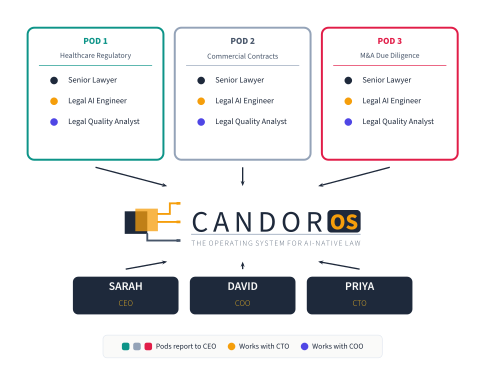
“Think of each pod as a small business within the firm,” he explained. “The pod has its own clients, its own workflows, its own quality metrics. The firm provides the platform—the technology infrastructure, the brand, the administrative support—but the pod delivers the work.”
He tapped the whiteboard. “Notice the reporting lines. Each pod reports to Sarah on client outcomes. But the AI engineers also coordinate with Priya on platform and pipeline work, and the Legal Quality Analysts coordinate with me on process and verification standards. Dual accountability—the pod owns the outcome, and the functional leaders own the capability.”
“How many pods can we support?” Priya asked, already thinking about the technology implications.
“With the current platform, two. Once you build the modular pipeline, probably at least ten or more. Each pod can handle fifteen to twenty simultaneous engagements depending on complexity. So that is a lot in the aggregate. Like one hundred and fifty or more simultaneous engagements.”
“And how do pods specialize?” Sarah asked. “Does each pod focus on a practice area? A client? A service type?”
“Initially, we have to remain flexible and not specialize too much. With two pods, you have to take the work that comes in. As we grow, pods will naturally develop expertise. We can let specialties emerge from the work rather than imposing it from above. Premature specialization kills flexibility.”
Priya raised a practical concern. “What about the technology layer? Does each pod maintain its own AI pipelines, or do they share a common platform?”
“Both,” David said. “The firm maintains a shared platform: the core infrastructure, the foundational models, the monitoring systems. That is your domain, Priya. But each pod has the ability to configure and tune the platform to the ‘last-mile’ requirements of specific work. Think of it like a shared kitchen with personalized workstations. The ovens, the refrigerators, the ventilation—those are shared infrastructure. But each chef has their own knives, their own mise en place, their own recipes.”
“So the platform team builds the kitchen,” Priya said, “and the pod engineers customize their stations.”
“Exactly. And when a pod discovers a better recipe, the platform team evaluates whether it should become standard across all pods.”
Sarah looked at the diagram again. The structure David had drawn was the opposite of a pyramid. The pods sat at the top, closest to the client. Leadership sat at the bottom, furthest from the work but responsible for the infrastructure that made it possible. It was an inversion of every org chart she had ever seen at a law firm.
She could see the efficiency gains. But she could also see the tension. Lawyers were trained as individual practitioners. They built their identities around personal expertise, personal client relationships, personal reputations. Putting them in pods—making them dependent on engineers and analysts for their output—was asking them to give up a kind of professional autonomy and identity that law school and BigLaw had spent years drilling into them.
“This is going to require a certain kind of lawyer,” she said.
“Yes.” David did not sugarcoat it. “You need lawyers who are secure enough in their expertise to share the stage with non-lawyers. Lawyers who care more about the client outcome than about who gets credit for the work.” “That is a smaller pool than you might think,” Sarah interjected.
The ‘pod’ model draws on principles from agile software development, Lean manufacturing, and integrated practice units in healthcare. What distinguishes the pod from a traditional law firm team is the deliberate inclusion of non-legal roles, engineers and analysts, as equal members of the delivery unit, not as support staff subordinate to the lawyers.
At its core, the pod addresses the central organizational challenge of AI-native professional services: the work requires multiple disciplines operating in tight coordination. Legal judgment, technical design, and quality assurance are distinct competencies that must converge on every engagement. Traditional structures, where lawyers sit in one department and technology staff in another, create handoff delays, communication failures, and misaligned incentives. The pod eliminates these problems by co-locating the competencies and giving the team shared accountability for outcomes.
Search, Sell, Onboard, Deliver
Sarah’s next two lawyer hires arrived the same week. She had spent months recruiting them, and they were precisely the kind of lawyers David had described: experienced enough to exercise independent judgment, curious enough to work alongside engineers, and pragmatic enough to see the opportunity rather than the risk. Joshua and Elena had been carrying the legal workload since the beginning. Two more senior lawyers would let her launch the pod structure for real.
Megan Rivera had spent five years at a large firm doing pharmaceutical regulatory work before moving in-house to a biotech company. She understood the substance of regulatory compliance deeply and had grown frustrated with both the inefficiency of outside counsel and the limitations of in-house teams that lacked the resources to handle surge work. She was thirty-four, direct, and had a quiet confidence that came from knowing her domain cold.
Ryan Gallagher had come from a different path entirely. He had practiced securities law at a mid-sized firm for three years, then left to join a legal tech startup as a “legal product specialist”—a hybrid role that had him designing workflows and testing AI systems. When the startup ran out of funding, he returned to practice. The detour had given him fluency in both law and technology that was rare in the profession. He was thirty-one, energetic, and had the slightly restless quality of someone who had seen the future and could not go back to pretending it was not coming.
Sarah assembled the full team in the conference room on their second day. It was a small gathering: herself, David, Priya, Joshua, Elena, Megan, Ryan, and two support staff. Nine people in a room designed for twenty. But the conversation that followed would define the firm’s culture for years to come.
“Look around. This is not the typical hiring model. I have assembled our entire team for this conversation and I want to be transparent about what we are building,” Sarah began. “This is not a traditional law firm. We do not have a partnership track in the way you would recognize it. We do not have associate classes. We generally do not bill by the hour. If you are looking for the conventional career path—grind for eight years, make partner, collect distributions—you are in the wrong place.”
Megan and Ryan exchanged a glance. Ryan spoke first.
“So what is the path?”
Sarah had anticipated the question. She had spent three late nights with David working through exactly this problem, and she was not entirely satisfied with the answer. But she owed them honesty, not polish.
“We are building something new, and I will not pretend we have every answer figured out. But here is how I think about it.” She stood and walked to the whiteboard where David’s pod diagram was still drawn. “In a traditional firm, there is one path: associate to senior associate to partner (and other levels of partner because not all partners are made equal). Bottom line—you climb the pyramid. The skills that matter are billable hours, client origination, and political survival. That single path determines compensation, status, and career trajectory.”
“We have three paths.” She drew three vertical arrows on the whiteboard, side by side. “The first is Delivery Leadership. This is for lawyers who want to own client outcomes and build teams. You start as a pod member, develop expertise in AI-supervised legal work, and grow into leading a pod, then multiple pods, then a practice area. Your value to the firm is the quality and efficiency of client delivery under your leadership. The destination is what we are calling a Delivery Partner—you own a portfolio of client relationships and bear responsibility for the quality of everything your pods produce.”
She labeled the second arrow. “The second is the Technical Path. This is for technical people like Priya, and potentially for lawyers (and ex-lawyers) who develop deep technical skills (and eventually we are planning to help folks develop those deep technical skills through training). You start as a analyst or engineer, develop expertise in building and improving our AI systems, and grow into leading the platform itself. Your value is the capability of the technology that powers every pod. The destination is Technical Partner—you own the firm’s technology architecture and drive the innovation that keeps us ahead.”
The third arrow. “The third is Client Development. This is for people who are exceptional at understanding what clients need and building relationships that generate long-term value. You start in a client-facing role, develop a portfolio of relationships, and grow into leading our market development. The destination is Client Partner—you own the firm’s growth engine.”
Megan studied the whiteboard. “Can you move between paths?”
“Yes. Especially early on. In fact, I expect most people will develop skills across all three. The paths are not silos—they are areas of emphasis. A Delivery Leader who develops strong client relationships is more valuable than one who does not. A Technical Leader who understands client needs builds better systems than one who does not. The paths are about recognizing that excellence looks different for different people, and that the old model of forcing everyone through the same funnel was wasteful.”
Ryan leaned back in his chair. “What does compensation look like?”
“Base salary plus equity plus performance-based bonus tied to pod outcomes,” Sarah said. “The equity is real. We are structured as a corporate entity under Arizona ABS, not a partnership. You have stock options that vest over four years. If we succeed—and I believe we will—the equity is where the meaningful wealth creation happens. The annual compensation will be competitive but not what a seventh-year associate at a large firm makes. The total package, including equity, should exceed it within five years.”
“And partner?” Megan asked. “You keep using that word. What does it actually mean here?”
Sarah paused. This was the question she had wrestled with most. The word partner carried enormous weight in professional services. It meant ownership, governance, prestige, economic participation. It was the brass ring that justified a decade of grinding. In her firm, it meant something different.
“Partner in our context means three things. First, you have a more meaningful equity stake: not options, but actual ownership. Second, you have governance rights: a voice in how the firm is run, not just a seat at the table but a vote. Third, you have economic participation beyond salary—a share of the firm’s profits proportional to your contribution.”
She met their eyes. “What it does not mean is what it meant at my old firm. It does not mean you own a piece of a static pie that gets divided every year. It means you own a piece of a growing enterprise. The value comes from building something that appreciates, not from extracting annual distributions.”
“So it is more like a tech company than a law firm,” Ryan said.
“Exactly. We are a professional services firm structured as a technology-enabled corporation. The legal work is what we do. The corporate structure is how we do it. The AI platform is what makes the economics work. All three have to operate together.”
The room was quiet for a moment. Sarah could feel the weight of what she was asking them to accept. Walk away from the known path. Trust that this new model would work. Bet their careers on a firm that was eight people in a rented office in downtown Phoenix.
Megan broke the silence. “I left BigLaw because the path was clear and the destination was not worth the journey. At least here the destination is worth pursuing, even if the path is still being drawn.”
Ryan nodded. “I am in. But I want to revisit the career framework in six months. Not because I do not trust it, but because we will learn things in six months that we do not know now.”
“Deal,” Sarah said. “Everything here is subject to revision based on what we learn. That is true of the career paths, the pod structure, the technology architecture. It is true of all of it. We are pioneers operating on the frontier of professional services. The only thing that is not negotiable is the commitment to building something that actually works better than what exists.”
David caught Sarah’s eye as the meeting broke up. “That went better than I expected.”
“They are the right people,” Sarah said. “If they were not asking questions, I would be worried.”
“The career path question is going to come up again,” David said. “Not from Megan and Ryan—they get it. From the next ten people you hire. People who did not choose this firm because they are true believers. People who chose it because the opportunity looked good and now want to know what good looks like in five years.”
“I know. We need to write it down. Make it formal. Not a forty-page partnership agreement, but something clear enough that people can plan their careers around it.”
“I will draft something this weekend,” David said. “A career framework document. One page per track. Milestones, expectations, timeline ranges. We can iterate from there.”
Sarah nodded. The informality that worked at eight people would not survive at thirty, fifty or one hundred and beyond. She was learning, in real time, the difference between a startup and a proper organization.
Rewriting the Career Playbook
The conversation with Megan and Ryan forced Sarah to articulate something she had only intuited. A single career path from associate to partner, with minor variations had been designed for a different organization from the one that Sarah was building. The pyramid rewarded a particular set of skills: client origination, billable hour production, and the political acumen to survive a decades-long tournament. In an AI-native firm, value creation was distributed across wholly different competencies.
The three-track career model Sarah outlined reflected a broader structural shift. Traditional professional services firms had offered a single career path because they had a single value-creation model: the staffing pyramid. Partners generated value by supervising junior labor. Associates generated value by billing hours. The only question was whether an associate could eventually generate the client relationships and billings to justify a partnership share.
AI-native firms generate value differently. The Delivery Leadership track recognizes that client outcomes require human judgment that AI cannot replicate: the ability to assess risk, manage ambiguity, and provide the kind of counsel that builds long-term trust. The Technical track recognizes that the AI platform itself is a source of competitive advantage—the engineers and architects who build and improve it create value that compounds across every engagement. The Client Development track recognizes that in a world where technology enables firms to serve more clients more efficiently, the constraint shifts from production capacity to market access.
Each track has its own progression, its own milestones, its own definition of excellence. A Delivery Leader is measured by client satisfaction, output quality, and team development. A Technical Leader is measured by platform capability, system reliability, and innovation velocity. A Client Leader is measured by revenue growth, relationship depth, and market positioning. All three contribute to the firm’s enterprise value, and the compensation model (base salary plus equity plus performance bonus) arguably better aligns individual incentives with firm-level outcomes.
The critical innovation is that all three tracks lead to partner-equivalent status. In traditional firms, the technical expert who did not originate clients was often in a challenging position regardless of their actual contribution. In Sarah’s model, a Technical Partner who builds the platform that powers the firm’s competitive advantage has the same governance rights, the same equity participation, and the same organizational standing as a Delivery Partner who manages the firm’s largest client relationship. This is not egalitarianism for its own sake. It is a recognition that the firm’s value depends equally on all three functions, and the organizational design must reflect that reality.
The pods came together faster than Sarah expected. Within two weeks of Megan and Ryan starting, the firm had its first two functioning pods. Pod One was led by Megan which started to focus more and more on healthcare regulatory compliance. That work had been rolling in the door ever since Sarah’s early client wins. Ryan joined Pod Two which was taking on commercial contract negotiation and review as well as certain forms of diligence work that had been Sarah’s bread and butter. Joshua and Elena, who had been carrying the legal workload since the early months, shifted into senior lawyer roles within the pods—Joshua in Pod Two alongside Ryan, Elena splitting her time across both pods as a floater handling overflow and complex edge cases that required a second set of eyes.
Priya assigned dedicated Legal AI engineers to each pod: Arun, a former backend developer from a health tech startup, went to Pod One, and Nadia, who had built document processing pipelines at a fintech company, went to Pod Two. Priya rotated between them, tuning the AI pipelines specific to each pod’s work while maintaining the shared platform underneath. David had hired two Legal Quality Analysts, both from non-legal backgrounds: Karen, from pharmaceutical quality assurance, who understood verification protocols, and Wei, from a data analytics firm, who could spot statistical patterns in error rates. Karen went to Pod One, Wei to Pod Two.
While they would eventually get their ‘sea legs,’ the first month was rough. The pod members were learning new workflows, new communication patterns, new ways of thinking about their work. Megan, accustomed to working independently on regulatory matters, had to learn to trust that the Legal AI engineer in her pod was not encroaching on her professional judgment but enabling her to focus it where it mattered most. Ryan, who had experience with legal technology, adapted faster but struggled with Wei’s insistence on documenting every correction to AI output. Joshua was the quietest about the transition. He did competent work in Pod Two, but Sarah noticed he rarely engaged with Nadia on pipeline questions and tended to review AI output the way he had always reviewed associate work—line by line, manually, as if the system were just another junior lawyer who needed supervision rather than a tool that needed calibration. She made a mental note to check in with him.
“Why do I need to log every time I fix a comma splice in a contract summary?” Ryan asked during a pod retrospective—a weekly meeting David had instituted, borrowed directly from agile software development.
“Because the comma splice is not the point,” Priya explained, sitting in on the retrospective. “The point is the pattern. If the AI is consistently mishandling a particular clause type, or a particular document format, we need to know. Every correction you log is training data for the next version of the pipeline. In three months, the comma splices will be gone. But only if we capture them now.”
Ryan absorbed this. “So I am not just reviewing the output. I am training the system.”
“You are both. And that dual role—legal reviewer and system trainer—is what makes this model work. You cannot automate what you cannot measure. You cannot measure what you do not capture.”
The pod retrospectives became the heartbeat of the firm. Every Friday afternoon, each pod reviewed its week: engagements completed, quality metrics, cycle times, client feedback, system improvements. David facilitated, tracking trends across pods and identifying opportunities for cross-pollination. When Pod One developed a particularly effective work cadence for regulatory compliance reviews, David helped Pod Two adapt it for contract analysis. When Pod Two discovered that a specific technical approach dramatically improved the AI’s handling of indemnification clauses, the improvement was rolled out to all pods within days.
On a Tuesday morning in Pod One’s second month, Megan’s pod received a new engagement: a regional hospital group needed its internal policy and procedure manuals reviewed against updated HHS data privacy requirements and a patchwork of new state-level privacy laws that had taken effect across multiple jurisdictions in the previous six months. The hospital group operated twelve facilities across three states, each with its own set of operational policies that had been drafted at different times by different administrators. Some were current. Some had not been updated since 2019. The deadline was ten business days.
Arun had the pipeline configured by noon. The challenge was not a single regulatory framework but the intersection of multiple ones—federal HHS requirements, plus state privacy statutes in each jurisdiction where the hospital group operated, each with its own definitions of protected information, breach notification timelines, and consent requirements. He loaded the federal framework first, then layered in the state-level variations, configuring the system to flag provisions where a policy might comply with HHS but fall short under one or more state laws. By 2 PM, the system was processing the first batch of manuals.
Karen watched the output stream in real time. The AI was handling the straightforward cases well—policies that were either clearly compliant or clearly outdated. But she flagged a cluster of results where the confidence scores hovered in the 0.72 to 0.78 range, below the pod’s threshold of 0.80. The pattern was consistent: the hospital group’s patient data handling procedures referenced “applicable federal law” without specifying how they addressed state-level requirements that went beyond HIPAA. In states with stricter consent provisions, that ambiguity could mean the facility was operating under a policy that satisfied federal regulators but not the state ones.
Megan reviewed the flagged manuals and saw the problem immediately. It was not that the policies were wrong. It was that they were drafted in a world where HIPAA was the ceiling, not the floor. The new state laws had raised the bar in specific ways—shorter breach notification windows in some jurisdictions, expanded definitions of personal health information in others, opt-out consent requirements in still others—and the hospital group’s policies had not caught up. Twelve facilities, three states, and a set of internal procedures that created compliance gaps not because anyone had made a mistake, but because the regulatory landscape had shifted beneath them.
She wrote up the gap analysis in forty minutes, mapping each policy against both the federal and relevant state requirements, color-coding the gaps by severity and by which facilities were affected. At her old firm, the same analysis would have required a junior associate spending two full days reading the manuals, a senior associate cross-referencing the regulatory texts, and a partner reviewing the final work product. Here, the AI had ingested the manuals and the regulatory frameworks, Arun’s pipeline had structured the cross-referencing, Karen had caught the pattern the AI was uncertain about, and Megan had applied the judgment. The output was not just faster—it was more systematic, because the pipeline checked every policy against every applicable requirement rather than relying on a human reviewer to hold multiple regulatory frameworks in their head simultaneously.
“Build a jurisdictional regulatory overlay module,” Megan told Arun. “If we are going to do healthcare work across multiple states, we need the pipeline to automatically identify which state laws apply based on facility location and flag the delta between federal and state requirements. This should not require manual configuration every time.”
Arun built the module in two days. It pulled from a regulatory database Priya had connected to the platform and automatically mapped facility locations to applicable state privacy laws. The next time a multi-state healthcare client came through—and they would—the pipeline would handle the cross-referencing out of the box. One engagement, one structural improvement, one permanent expansion of the platform’s capability. The learning loop in action.
Not every pod interaction ran that smoothly. In Pod Two’s third week, Ryan and Wei clashed over a set of commercial contracts that Ryan wanted to push to the client by end of day. Wei had flagged inconsistencies in the risk ratings across a batch of forty contracts—not errors, exactly, but variations in how the AI weighted limitation of liability clauses depending on contract length. Wei wanted to recalibrate before delivery. Ryan wanted to ship.
“The ratings are defensible,” Ryan said. “The variation is within acceptable range. The client is waiting.”
“Defensible is not the same as correct,” Wei said. “If we deliver inconsistent ratings and the client notices, we lose credibility. That is worse than being a day late.”
They escalated to David, who listened to both sides and ruled in Wei’s favor. “We are building a reputation. The first dozen engagements define what clients expect from us. Ship it tomorrow with consistent ratings. Ryan, you call the client and tell them we are taking an extra day for quality. Frame it as diligence, not delay.”
Ryan made the call. The client appreciated the transparency. Wei recalibrated overnight, and the final output was clean. But the friction was real, and Sarah noted it. The pod model worked because the three roles checked each other. When the checking felt like friction rather than quality, the culture had to be strong enough to hold.
David had been describing the organizational learning loop since their first coffee at Lux. The pod structure was not just about efficiency. It was about creating an organization that got smarter with every engagement. Each client project generated not only revenue but also data, process improvements, and institutional knowledge that made the next project better. Although there had been decades of efforts devoted to knowledge management (KM), the traditional law firm model struggled to capture this systematically. Compounding knowledge in technology systems was rarely core to the business model. Thus, much of the knowledge lived in individual lawyers’ heads and walked out the door when they left. Sarah’s model captured it in the platform, where it compounded.
The Staffing Ratio Question
One evening after the pods had been running for three weeks, Sarah and David sat in her office reviewing the numbers. David had been tracking a metric he called “effective ratio”: the volume of AI-processed work relative to human-verified work within each pod.
“In a traditional firm with a 6:1 staffing ratio,” David said, “one partner supervises six associates. The associates do the work. The partner reviews it. The economics depend on the spread between what associates cost and what clients pay for their time.”
“Our ratio is different,” Sarah said.
“Entirely different. In Pod One, Megan reviewed AI output equivalent to what eight associates would have produced in the same period. She did it with one engineer and one Legal Quality Analyst. The effective ratio is not 6:1 human to human. It is something closer to 1:1 human to human, but with AI handling the output volume of six to eight additional people.”
“So the economics work because we replaced associate labor cost with compute cost.”
“Partly. But the bigger shift is that the senior lawyer’s time is being used differently. At your old firm, a partner spent maybe forty percent of their time on actual legal judgment—the rest was supervision, administration, business development, internal politics. In our model, Megan spends seventy percent or more of her time on substantive legal judgment and client interaction. The engineering and quality functions handle the rest.”
Sarah pulled up the revenue figures. “Forward looking revenue per professional in Pod One is tracking at roughly $120,000 per month across the three pod members. Annualized, that is around $480,000 per professional. Roughly in line with the lower end of the Am Law 200 average.”
“And that will improve as the platform matures,” David said. “Right now, Priya’s team is still building and tuning. Once the core pipelines are stable, each pod will handle more volume with the same headcount. Revenue per professional should cross $700,000 within eighteen months, and the margins will be dramatically better than a traditional firm carrying all that associate overhead.”
Fast on Tech, Deliberate on People
The governance question surfaced during a board meeting a few months after the pod structure launched. Alex had flown to Phoenix for the quarterly review. Rachel attended by video. The independent director, Margaret Adeyemi, sat at the head of the conference table with the quiet authority of someone who had spent thirty years as a general counsel and had no patience for posturing.
Sarah presented the numbers: twelve engagements completed, two pods operating, revenue ahead of projections, client satisfaction uniformly high. Then she presented the challenge: she needed to hire faster. The demand was outpacing capacity. Three potential clients were waiting for pods that did not yet exist.
“How fast can you stand up a new pod?” Alex asked.
“That is the bottleneck,” David said, pulling up a slide. “We can hire the Legal Quality Analyst in weeks. The Legal AI engineer takes weeks to a couple of months because Priya needs to train them on our platform. The senior lawyer takes at least a few months (and perhaps longer). We need someone with deep domain expertise who is also willing to work in a completely different model. That is a small talent pool. Finding a lawyer who somehow not completely captured by the cult of legal exceptionalism. Well it is diamond mining.”
“So hiring the senior lawyer is the constraint,” Margaret said.
“Always,” Sarah confirmed. “We can train engineers and analysts. We cannot easily train legal judgment. At least not overnight.”
“What if you hired less experienced lawyers and trained them up?” Alex asked.
Sarah shook her head. “That is the pyramid model. Hire junior, train them over years, promote the survivors. We do not have years. And the pod model does not work with junior lawyers. The senior lawyer in the pod needs to exercise judgment independently, without a partner looking over their shoulder. That requires experience.”
“Then your growth rate is constrained by the senior lawyer pipeline,” Rachel observed from the screen. “That is a structural limitation, not a temporary one.”
“Yes. And that is why I am not projecting hockey-stick growth in year one.” Sarah pulled up a revised hiring plan. “Realistic trajectory: three pods by end of year one, five to six by end of year two, eight to ten by end of year three. Each pod generates roughly $800,000 to $1.2 million in annual revenue as it ramps. That puts us at $2.5 to $3.5 million in year one, $5 to $7 million in year two, and $8 to $12 million in year three.”
Sarah pulled up the pod scaling timeline she and David had built the previous weekend. The visualization made the strategy concrete: two pods at launch, a third by end of year one, then steady expansion as the senior lawyer pipeline allowed. Each new pod added capacity and opened a new practice area—healthcare regulatory, commercial contracts, M&A and capital markets, financial regulatory, corporate. By year three, eight to ten pods covering the core mid-market legal needs that Allison McLindon and clients like her were paying four different firms to handle.
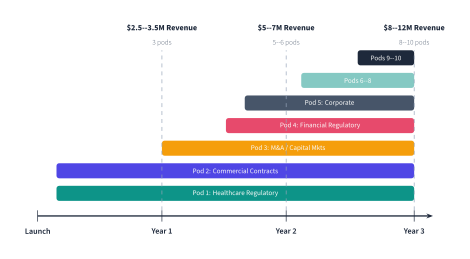
“The revenue projections are conservative,” David added. “They assume each pod generates the same revenue in year three as it does in year one. But that is almost certainly wrong. The learning loop improves the platform with every engagement. Cycle times come down. Error rates drop. Each pod should handle more volume over time without adding headcount. The per-pod revenue ceiling rises as the system matures.” Future revenues could reach $2M–$4M+ per pod.
Sarah nodded. “And pods are not silos. On larger matters—a full M&A transaction, a multi-state regulatory review—we can combine two or three pods into a temporary engagement team. The shared platform makes that seamless. The pods do not need to rebuild workflows from scratch because they are all running on Candor OS.”
“That is good growth but not venture-scale growth,” Alex said carefully.
“It is not supposed to be. We are not a software company where you ship code and scale infinitely. We are a professional services firm where the humans in the loop are the product differentiator. If we try to scale faster than we can hire senior talent, quality degrades, clients leave, and the whole model collapses.” Sarah met Alex’s eyes. “You invested in this because the economics work and the model is defensible. Defensibility requires quality. Quality requires the right people. The right people take time to find. This is the new world of law. We must improve the process of identifying and targeting the right type of folks who really are interested in working differently. Candor also has to build a world class training model for professionals of all ages and ranks. The McKinseys and Accentures of the world are legendary for their training programs and we have to embrace elements of that model as we scale.”
Alex was quiet for a moment, then nodded. “I appreciate the discipline as always. Most founders tell me what I want to hear about growth. You are telling me the truth about constraints. And I agree that training including technical training is going to be key here to us to $3M–$4M+ per pod.”
Margaret spoke up. “I want to add something on governance. As you scale the pod structure, you will need to formalize the quality oversight. Right now, Sarah reviews edge cases personally. That does not work at eight pods. You need a quality governance function that operates independently of the pods—someone whose job is to audit pod output, identify systemic issues, and enforce standards.”
“Like an internal audit function,” David said.
“Exactly. And it needs to report to the board, not to management. That is how you maintain professional independence at scale. The pods produce the work. The quality function audits the work. Management runs the business. The board ensures that all three are functioning properly.”
Sarah added it to the organizational roadmap: a Chief Quality Officer reporting to the board, to be hired when the firm reached five or more pods. Another role that no traditional law firm had ever created. Another piece of the structure that set this organization apart from anything that came before.
After the board meeting, Sarah walked Alex to his car. The Phoenix evening was warm, the downtown streets quiet in that particular way they got after the office workers had left but before the restaurant crowd arrived.
“Can I ask you something honestly?” Sarah said.
“Always.”
“Are you disappointed in the growth numbers?”
Alex stopped walking. “Sarah, I have invested in thirty-two companies. The ones that failed fastest were the ones that grew fastest. They hired ahead of revenue, scaled ahead of quality, and imploded when the foundation could not support the weight.” He paused. “You are building the foundation first. That takes longer. It is less exciting in quarterly updates. And it is the right thing to do.”
“Rachel seemed concerned about the structural growth constraint.”
“Rachel’s job is to identify risks. She identified one. Your job is to manage it, which you are doing.” He unlocked his rental car. “Build Pod Three. Prove the model works with three pods as well as it works with two. Then we will talk about the Series A and what real scale looks like.”
Sarah watched him drive away and thought about the paradox of what she was building. The whole point of an AI-native firm was efficiency and speed. But building the organization itself required patience—the patience to hire the right people, to design the right structures, to establish governance that would hold up under pressure. Moving fast on technology. Moving deliberately on people and process. Holding both speeds simultaneously.
It was, she thought, the hardest thing about being a founder. Not the technology decisions or the client pitches or the investor meetings. The constant calibration of when to sprint and when to walk.
Several months after the pod structure launched, Sarah sat alone in her office on a Friday afternoon leading into a three day holiday weekend. The building was quiet. The pods had finished their retrospectives and gone home. David’s whiteboard was covered in new diagrams—he had been sketching a third pod configuration, this one focused on M&A and mid-market capital markets / financing type work, where the firm was seeing growing demand.
She opened her laptop and reviewed the numbers. Fourteen engagements completed and several persistent engagements producing consistent revenue. Average client satisfaction score of 4.7 out of 5. Revenue run rate had climbed from $1.6 million at the time of the board strategy call to $2.0 million, roughly on plan. EBITDA margins at 30 percent which was still short of Maya’s 36 percent target, but climbing steadily. Two quality incidents, both caught by the Legal Quality Analysts before reaching clients. Zero malpractice claims. Zero bar complaints.
The numbers were good. But what struck Sarah was not the numbers themselves. It was how the numbers were being produced. Not by a pyramid of associates grinding through documents under partner supervision. Not by a heroic founder pulling all-nighters. By a system—a set of roles, teams, workflows, and governance mechanisms that operated reliably whether or not Sarah was in the building.
She thought about her old firm. Right now, on a Friday evening, the associates there would still be at their desks. Billing hours. Reviewing documents line by line. Waiting for a senior associate to review their review. Waiting for a partner to review the senior associate’s review. Layer upon layer of human review, each one catching some errors and introducing others, the whole process measured in billable hours rather than client outcomes.
Her firm did the same work in a fraction of the time, at higher quality, with a team that went home at a reasonable hour. Not because the people were better—the lawyers at her old firm were brilliant—but because the system was designed differently. The pod structure, the AI platform, the quality verification layer, the feedback loops that made the system smarter with every engagement. It was the organization itself that was the innovation, not any individual piece of technology.
Sarah closed her laptop and looked at the whiteboard one more time. David had written something in the corner, in his precise engineer’s handwriting:
“The goal is not to replace the pyramid writ large. It is not for us to decide how other folks should run their organization. Our goal is to build the structure that will allow Candor to thrive.”
She smiled. They were not there yet. But the foundation was laid. The structure was sound. The governance was real. They just needed to keep scaling on both the sales side and on the talent and culture side of things.
Sarah had talked to many startup founders in the time since she left the law firm. The message was consistent: culture cannot be added later, it must be built in from the start. The pod model was an explicit design choice. Non-lawyers could not be allowed to be second class citizens here. Why would the best talent in technology, in data science, in operations be willing to come join Candor if they were going to be marginalized? Lawyers with a law-centric view of the world, who thought they were the only smart people in the room—that was the old culture. Candor had to be different.
She thought about Priya, who could have easily taken another senior role at a well-funded fintech company and instead decided to join a small startup law firm. Priya had not made that choice because she wanted to work for lawyers. She made it because Sarah promised her she would be building something, not just supporting someone else’s practice. That promise had to hold as the firm grew. It had to hold when they were twenty people and when they were fifty. The moment an engineer felt like a second-tier employee servicing the lawyers above them, Candor would start losing the talent that made the whole model work.
David understood this instinctively. His healthcare background had taught him that the best outcomes came from teams where every role carried weight. A surgical nurse who felt marginalized did not speak up when she saw a problem. A quality analyst who felt like a subordinate did not push back when the senior lawyer rushed a deliverable. The culture of the pod—the real culture, not the one on the website—would determine whether the model scaled or collapsed under its own contradictions.
And then there was the question that kept Sarah up at night: how to measure any of this. David had his metrics such as cycle times, error rates, pod utilization. Priya had hers including platform uptime, model accuracy and pipeline throughput. But the metrics that mattered most for the next phase were the ones very few folks in legal had ever tried to track systematically. Client retention rates by pod. Revenue expansion within existing accounts. Time from first engagement to second engagement. The correlation between quality scores and client lifetime value. These were the numbers that would tell Sarah whether Candor was building something durable or just running fast on a treadmill.
The next phase of Candor’s story would not be about technology or strategy. It would be about people. Finding them, keeping them, training them and building the kind of workplace where a lawyer, an engineer, and a quality analyst could sit at the same table and know that each of them mattered equally. In many ways, that was harder than building a platform. And if done well, it was the thing that no competitor could easily copy.